
WATERPROOFING SERVICES
SERVICES OFFERED
We provide an exclusive remedy for customers dealing with wall dampness, ceiling leakage, wall seepage, and various waterproofing challenges. We take pride in showcasing our specialized waterproofing approach and process.
- Roof waterproofing (metal & concrete)
- Roof gutter waterproofing
- Wet areas waterproofing – kitchen & bathroom
- Basement waterproofing
- Injection waterproofing
- Dampness & peeling paint waterproofing
- Concrete water tank waterproofing
- Concrete roof waterproofing
- Crack repair waterproofing
- Swimming pool waterproofing
- Pipe drain waterproofing
- Cementitious waterproofing
- Liquid membrane waterproofing
- Water or acrylic-based
- Bituminous waterproofing membrane (app membrane)
- Polyurethane liquid membrane
- Grout & epoxy injection
- App membrane
- Gunniting work for basement etc
- Thermal insulation work
- Mud phuska terracing with tile paving
CEMENTITIOUS WATERPROOFING
LIQUID MEMBRANE WATERPROOFING

GROUT & EPOXY INJECTION
GUNNITING WORK FOR BASEMENT
CEMENTITIOUS WATERPROOFING
We provide an exclusive remedy for customers dealing with wall dampness, ceiling leakage, wall seepage, and various waterproofing challenges. We take pride in showcasing our specialized waterproofing approach and process.
- Basement Waterproofing.
- Dampness & Peeling Paint waterproofing.
- Concrete Water Tank Waterproofing.
- Concrete Roof Waterproofing.
Cementitious waterproofing systems come in 4 forms:
- Metallic
- Crystalline
- Chemical additive
- Acrylic-modified
ADVANTAGES OF CEMENTITIOUS WATERPROOFING MEMBRANES
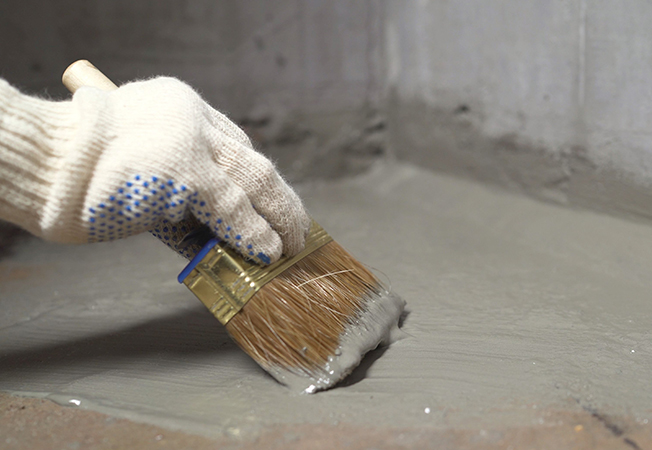
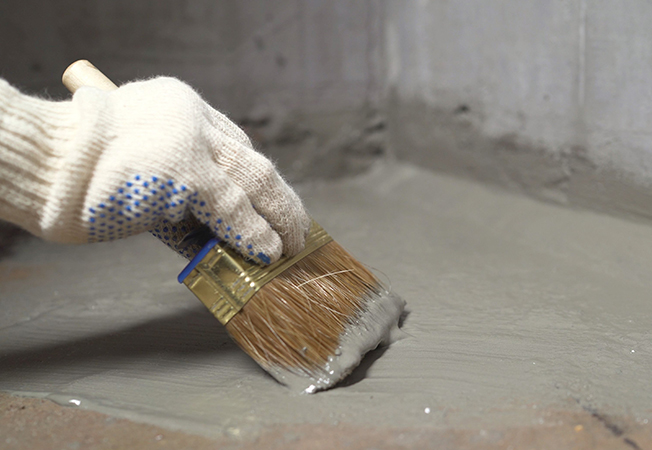
- Flexible cementitious waterproofing membranes are crafted from a blend of cement, with or without sand, a waterproofing agent, and a bonding material. These components are combined into a relatively thin liquid that can be applied to surfaces using a roller, spray, or brush. Once applied, the coating undergoes curing to create a waterproof membrane.
- In the past, a drawback of cementitious waterproofing was its lack of flexibility, leading to cracking, especially around joints, due to the limited stretchability of cement. However, technological advancements have successfully addressed this issue.
- Modern flexible cementitious waterproofing, enhanced with elastomers (polymers with rubber-like elasticity), is commonly employed to waterproof concrete and masonry walls and floors susceptible to cracking. This system is also applicable to green roofs and the sealing of water tanks.
DURABILITY OF A CEMENTITIOUS WATERPROOFING SYSTEM
Several factors impact the lifespan of a cementitious Waterproofing system:
- Quality of Materials
- Method of Application
- Number of Coatings Applied
- Condition and Preparation of the Substrate
- A silicate-based chemical cementitious waterproofing system, forming a calcium silicate hydrate barrier, can last a lifetime without breaking down. Other cementitious waterproofing systems may endure for up to 10 years.
LIQUID MEMBRANE WATERPROOFING
(WATER OR ACRYLIC-BASED, BITUMINOUS WATERPROOFING MEMBRANE (APP MEMBRANE), POLYURETHANE LIQUID MEMBRANE)
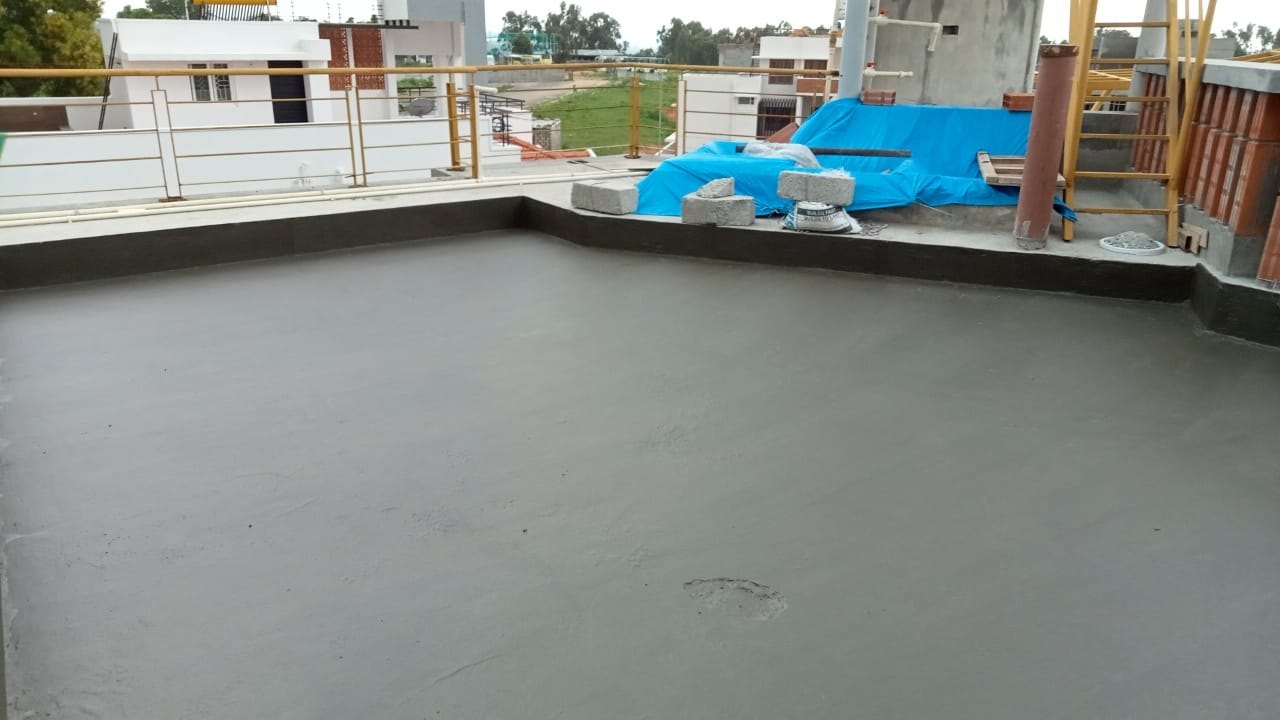
Liquid waterproofing membranes can be placed into three main categories – water or acrylic-based, polyurethane, and bituminous. Each one is designed for use in specific conditions and for different applications from basement and foundation walls to kitchens, wet rooms, and bathrooms.
WATER OR ACRYLIC-BASED
Water/acrylic-based liquid waterproofing membranes are usually made from a combination of acrylic polymers and other additives, making them highly resistant to water and other environmental factors, such as UV radiation.
TYPICAL USAGE
Water/acrylic-based waterproofing membranes are commonly used in applications where exposure to sunlight is a concern and can be applied to a variety of different surfaces due to their high flexibility.
Some common uses for water/acrylic-based liquid waterproofing membranes are roofing, balconies and decks, kitchens or wet rooms, bathrooms, and showers. They can withstand exposure to sunlight, rain, and other weather conditions, and can be applied to a variety of different surfaces, such as concrete, wood, or metal.
- Basement Waterproofing.
- Wet Areas Waterproofing – Kitchen, Bathroom and Showers.
- Concrete Water Tank Waterproofing.
- Roofing, balconies and decks.
BITUMINOUS WATERPROOFING MEMBRANE
(APP MEMBRANE)
Bituminous membranes are made from a mixture of bitumen and other materials such as polyester or fibreglass. They are highly resistant to water and can be applied to a variety of different surfaces including concrete, metal or wood.
TYPICAL USAGE
Bituminous liquid waterproofing membranes are often used in roofing applications including flat roofs and can be applied either hot or cold. Additionally, bituminous membranes are used to waterproof the foundations of a building or structure. They prevent water from seeping in and can be applied to both horizontal and vertical surfaces. Bituminous membranes are also used in the construction of tunnels and in the lining of liquid retentive tanks.
- Waterproofing Roofs
- Basements
- Below-Ground Structures
- Bridges And Other Structures
POLYURETHANE LIQUID MEMBRANE
Polyurethane membranes are highly elastic and can withstand both positive and negative hydrostatic pressure. They are commonly used in roofing applications and can resist exposure to sunlight and other environmental challenges.
TYPICAL USAGE
Polyurethane membrane can conform to any shape or size of roof and is particularly effective in areas with complex geometries. They also offer an effective solution when keeping foundations watertight, can withstand the high pressure of water that can occur during flooding or heavy rain, and can be applied to both the interior and exterior of the foundation.
- Basement Waterproofing.
- Concrete Water Tank Waterproofing.
- Roofing, balconies and decks.
- Walls or floors of buildings such as tunnels,
- Bridges
- Concrete Wall
GROUT & EPOXY INJECTION
Epoxy grouts are three-component products. They have an epoxy resin, a hardener, and a graded aggregate. The resin and hardener serve as an adhesive in the mortar, while the aggregate serves as a filler to reduce costs Used to seal & inject cracks in concrete floors, walls & structures. Because it provides deep penetration, shrink free solid mass, strong bonding inside the cracks and Excellent resistance to honey combing & chemicals
TYPICAL USAGE
- Permanent bonding solution for concrete cracks.
- Repair of crack concrete areas in floors, walls, tanks & sea walls.
- Injection in to cracks
- honey combing in concrete & masonry.
- Crack repair Waterproofing
APP MEMBRANE
APP, which stands for Atactic Polypropylene, is widely utilized as a waterproofing material for concrete roofs and low-slope roofs. The application of APP membrane involves torching it onto asphalt surfaces. Beyond roofing applications, this versatile membrane proves effective in safeguarding various structures, including man-made ponds, bathrooms, water tanks, curtain walls, and concrete channels, offering reliable protection against water infiltration. Contractors often prefer the durability of APP membrane when aiming to secure surfaces and prevent leakage.
TYPICAL USAGE
- Concrete roofs
- Low-slope roofs
- Man made ponds
- Bathrooms
- Water tanks
- Curtain walls
- Concrete channel
GUNNITING WORK FOR BASEMENT
Guniting stands out as a vital procedure in the realm of construction, offering a rapid and adaptable approach with numerous benefits. If your goal is to construct durable retaining walls, tunnels, liquid storage tanks, or pools, prioritizing this process is essential. Guniting serves as an effective damp-proofing technique, employing pressure to apply a substantial layer of cement mortar onto exposed walls and pipe surfaces. Typically, a mixture of 1 part cement to 3 parts sand is utilized for this purpose.
TYPICAL USAGE
- Basement waterproofing
- Dampness & peeling paint waterproofing.
- Liquid storage tanks
- Construct durable retaining walls
- Pools
- Damp-Proofing
THERMAL INSULATION WORK
EXTRUDED POLYSTYRENE BOARDS (XPS BOARDS)
Extruded Polystyrene (XPS) Thermal Insulation Board is a rigid foam board extruded from polystyrene, having closed cell structure. Extruded polystyrene (XPS) boards improve a building’s energy efficiency by providing a complete layer of insulation on the wall and roof. This method of terracing is equally suitable to hot as well as arid regions, and is commonly used over R.C.C roofing. The work is carried out in the following steps. The R.C.C slab is cleared off dust and loose material. A layer of hot bitumen is spread over it at the rate of 1.70 kg of bitumen per square metre of roof surface.
TYPICAL USAGE
- Wall and ceiling insulation,
- Cool rooms & refrigeration,
- Under concrete slab (i.e. car park), and even
- For architectural modelling
VERMICULITE ROOF DECK AND INSULATION
Vermiculite, when exfoliated, is widely recognized for its exceptional thermal insulation capabilities, enduring temperatures surpassing 1000°C. Its loose-fill form ensures easy installation, particularly in applications like loft insulation. The insulation attributes of Vermiculite play a crucial role in minimizing heat loss during cold weather and maintaining a cool interior in hot conditions. Additionally, Vermiculite is user-friendly, non-abrasive, possesses sound-absorbing qualities, resists decay, lacks Odor, and is non-irritating.
TYPICAL USAGE
- Within a house is as a loft or attic insulation
- Can also be used within cavities and voids inside a house under concrete slab (i.e. Car park), and even
- Acoustic insulation within internal walls.
- Can be used as chimney liner insulation
MUD PHUSKA TERRACING WITH TILE PAVING
- This method of terracing is equally suitable to hot as well as arid regions, and is commonly used over R.C.C roofing. The work is carried out in the following steps.
- The R.C.C slab is cleared off dust and loose material. A layer of hot bitumen is spread over it at the rate of 70 kg of bitumen per square metre of roof surface.
- A layer of coarse sand is immediately spread over the hot coat of bitumen, at the rate of 6 m3 of sand per 100 m3 of roof surface.
- Mud-phuska is prepared from puddle clay mixed with bhusa at the rate of about 8 kg of bhusa per m3 of clay. A 10 cm thick layer of this mud-phuska is applied over the sand- bitumen layer. Proper slope (usually 1 in 40) is given in mud-phuska layer. Alternatively, slope may be given in RCC slab itself.
- The mud-phuska layer is consolidated properly. It is then plastered with 13 mm coat of mud-cow-dung mortar (3:1)
Tile bricks are laid flat on plastered surface. The joints are grouted is 1:3 cement mortar.